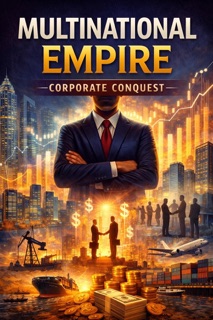
In an age when the world's largest economic entities are not nations but corporations, when a handful of technology giants mediate reality for billions, and when corporate decisions shape everything from what we eat to how democracies function, understanding corporate power has never been more urgent. Multinational Empire: Corporate Conquest offers an unflinching examination of how multinational corporations have achieved dominance that rivals the imperial projects of previous centuries—not through military force, but through sophisticated mechanisms of economic, political, and cultural control.
This comprehensive work traces the evolution of corporate power from the East India Company's fusion of commerce and sovereignty to today's digital platforms that extract data and attention as new forms of primitive accumulation. Through twenty meticulously researched chapters, the book reveals how corporations have systematically captured markets, resources, labor, and democratic institutions themselves. It exposes the financial engineering that turns risk into reward, the supply chains that fragment production across borders to maximize exploitation, the lobbying machines that write legislation, and the brand imperialism that homogenizes culture globally.
Yet this is not merely a catalog of corporate misdeeds. The book grapples honestly with corporations' genuine contributions—the innovations they've fostered, the efficiency they've achieved, the wealth they've generated—while asking the essential question: at what cost, and for whose benefit? It examines how pharmaceutical companies balance lifesaving innovation against profit-driven drug pricing, how agricultural corporations feed billions while destroying biodiversity and farmer autonomy, and how technology platforms connect humanity while enabling unprecedented surveillance and manipulation.
Crucially, Multinational Empire documents resistance. From labor movements organizing despite brutal suppression to indigenous communities blocking extractive projects, from consumer boycotts to shareholder activism, the book chronicles how people have contested corporate power throughout its history. It explores alternative economic models—cooperatives, public ownership, stakeholder governance—that demonstrate possibilities beyond profit maximization.
The book confronts readers with fundamental choices about economic organization and democratic governance. Will societies continue allowing entities accountable primarily to shareholders to shape collective futures? Can regulations constrain behaviors driven by profit imperatives? What alternatives might emerge if communities reclaim control over economic life?
Written in accessible yet sophisticated prose, Multinational Empire synthesizes insights from economics, political science, history, and sociology into a narrative that is both intellectually rigorous and urgently relevant. It provides essential context for understanding contemporary debates about inequality, climate change, technological disruption, and democratic erosion—revealing how all connect to questions of corporate power.
This is not a book offering easy answers or simple solutions. Rather, it provides the analysis necessary for citizens, policymakers, activists, and students to understand the systems shaping our world and to imagine—and build—alternatives. In documenting the multinational empire's construction, it illuminates paths toward its transformation.