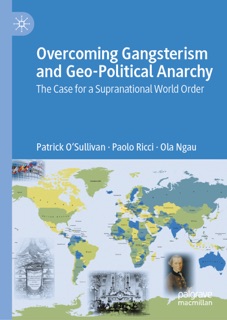
The contemporary geopolitical order is marked by profound instability: international law appears fractured and largely ineffective, might is often right as power prevails over principle. This book identifies one fundamental reason for the apparent gangsterish anarchy— lack of enforcement power for international institutions and the primary premise of international law being that of an effectively absolute national sovereignty. Drawing on the political philosophies of Hobbes and Kant this books advances a bold proposal: the creation of a supranational world authority endowed with genuine enforcement powers. Such an authority would require states to cede voluntarily limited aspects of sovereignty essential for sustaining global peace and addressing shared interdependent challenges. Far from being utopian, this vision finds precedent in and could be modelled upon the European Union, whose supranational institutions offer both lessons and cautionary tales for designing a global framework.
The book can be a starting point for a truly innovative and in our day much needed reflection on the future of geopolitical relations; and it sketches how a worldwide political cooperation, concretely inspired by values of solidarity and peace might be put in place. This book will be of interest to scholars of political theory, of international relations and of international law as well as political leaders and policy-makers the world over who are seeking truly lasting peace and prosperity.
Patrick O'Sullivan is an Adjunct Professor of Political Economy at the University of Warsaw
Paolo Ricci is a Professor of Public Accountability at the University of Napoli Federico II
Ola Ngau is General Secretary at the Professors Guild International Rimini
Including independent contributions from Francis Kim (Chulalogkorn University Bangkok), Alojzy Nowak (University of Warsaw), Daniela Russo (University of Napoli Federico II) and Alexandru Zgardan (Grenoble Ecole de Management)