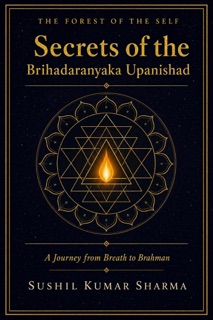
Among the oldest and most philosophically daring texts humanity has ever produced, the Brihadaranyaka Upanishad stands apart. Composed somewhere between the eighth and sixth centuries BCE in the forests of ancient India, it is not merely a religious document. It is a systematic investigation of the deepest possible question a conscious being can ask: What am I, truly, when everything I call "myself" is stripped away?
The Forest of the Self is the first book in English to approach the Brihadaranyaka Upanishad as both a rigorous philosophical system and a living guide for the modern reader. Written in the tradition of scholarly inquiry but with a warm, accessible human voice, this book invites readers , whether they come from philosophy, science, spirituality, or simply a restless curiosity about existence , into one of the world's most astonishing conversations about consciousness, reality, and liberation.
The book follows the Upanishad through nine carefully structured chapters. It begins with the great horse-sacrifice, unpacking why an ancient ritual becomes a meditation on the totality of the cosmos. It moves through the legendary debates of Yajnavalkya , the Upanishad's central sage, perhaps the most intellectually bold teacher in all of ancient India , as he methodically dismantles every assumption about what the Self is. It introduces us to Gargi Vachaknavi, the woman philosopher whose relentless questioning forces metaphysics to its very limit. And it explores the Madhu Vidya, the "Honey Doctrine," in which all of reality is understood as mutually nourishing , an idea that anticipates modern field theory and ecological philosophy by nearly three thousand years.
At the heart of this book lies the Brihadaranyaka's most radical claim: that the individual self (Atman) and the universal ground of being (Brahman) are not two things in relationship , they are identical. "Aham Brahmasmi." I am Brahman. This is not a metaphor or a devotional sentiment. In the Brihadaranyaka, it is a philosophical conclusion arrived at through sustained inquiry, a statement that dissolves the boundary between the knower and the known, between the observer of the universe and the universe itself.
Sushil Kumar Sharma brings to this text both the discipline of a scholar and the sensibility of a seeker. The result is a book that neither oversimplifies the profound nor hides behind unnecessary abstraction. The Brihadaranyaka's treatment of the three states of consciousness , waking, dreaming, and dreamless sleep , is explored in relationship to contemporary neuroscience and consciousness studies. Its analysis of fear, love, and the structure of identity speaks directly to modern existential concerns. Its vision of Prana , the breath that is simultaneously cosmic force and individual vitality , anticipates systems thinking and the science of interconnection.
This is a book for readers who sense that the great questions of modern science and philosophy , What is consciousness? Why is there something rather than nothing? Can a human being be free? , have been asked before, with astonishing precision, in the forests of ancient India.
The Forest of the Self is not a translation of the Brihadaranyaka Upanishad. It is a guided journey through it. Every concept is explained, every metaphor is unpacked, and every philosophical move is examined with care and clarity. Readers need no prior knowledge of Sanskrit, Vedic philosophy, or Indian religion. What they need is the willingness to sit at the edge of what can be known and look, with open eyes, into the forest that is themselves.