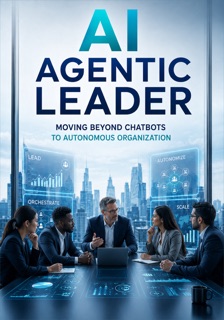
AI Agentic Leader is a practical leadership playbook for moving beyond chatbots, copilots, and scattered AI experiments into real enterprise transformation. This book explains how modern organizations can adopt, scale, and govern agentic AI in the real world, where compliance, risk, budgets, politics, legacy systems, data quality, and human resistance all matter.
The book explores the shift from AI as a tool people occasionally use to AI as an operating layer that can observe business events, trigger workflows, escalate exceptions, remember institutional knowledge, and operate within clear governance boundaries.
What You Will Learn
Inside this book, you will learn how to:
Move beyond chatbot thinking and basic prompt usage
Design agentic workflows that observe, reason, act, and escalate
Build governance into workflows instead of burying it in policy documents
Reduce human bottlenecks without removing human judgment
Measure AI value through decision velocity, autonomy, risk reduction, and opportunity capture
Lead teams of digital agents, automated workflows, and human professionals
Protect the human premium: judgment, originality, trust, empathy, and strategic taste
Who This Book Is For
This book is written for executives, managers, founders, consultants, technologists, product leaders, transformation teams, and professionals who want practical AI insight without the fluff.
It is especially useful for readers responsible for:
AI strategy and adoption
Digital transformation
Governance, risk, and compliance
Workflow automation
Product and technology leadership
Enterprise operating model redesign
Future-of-work planning
How to Read This Book
Read it straight through as a leadership playbook, or use it as a practical reference when working on AI strategy, governance, workflow design, automation, operating models, or team transformation.
Each chapter is designed to help readers ask better questions:
Are we automating value or just automating noise?
Are our governance controls real or performative?
Are humans adding judgment or simply slowing the system down?
Are we building enterprise capability or just collecting AI tools?
What work should disappear instead of being automated?
Why This Book Is Different
Many AI books explain the technology.
This book explains the enterprise reality.
It focuses on the awkward, expensive, politically complicated, operationally messy parts of AI adoption that determine whether transformation succeeds or becomes another pilot graveyard.
The winners in enterprise AI will not simply be the companies with the best models. They will be the companies with the best operating logic: knowing what to automate, what to govern, what to measure, what to delete, and where humans still matter most.
AI transformation is not about replacing people with machines. It is about redesigning work so humans and machines each do what they do best.