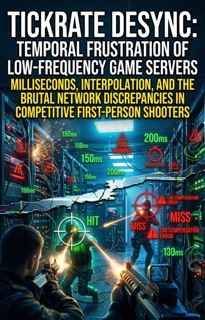
You pull the trigger, the crosshairs are perfectly aligned, yet the enemy player walks away unharmed while you instantly drop dead. In competitive First-Person Shooters, this infuriating phenomenon is rarely a lack of skill; it is a brutal limitation of temporal physics and network infrastructure. It is the inescapable reality of server tickrate desynchronization.
The server hosting a multiplayer match acts as the absolute arbiter of reality. However, it only updates its version of the world a set number of times per second—the "tickrate." If a game runs at a low 20Hz tickrate, the server only takes a snapshot of the action every 50 milliseconds. Between those ticks, the game engine must guess where players are moving using complex interpolation algorithms. When your client-side reality disagrees with the server's delayed snapshot, bullets pass harmlessly through digital ghosts.
This technical breakdown explores the high-stakes engineering of multiplayer netcode. You will analyze the geometry of client-side prediction, the financial cost of high-frequency 128Hz servers, and the algorithmic triage that decides who lives and who dies when internet connections lag.
Master the invisible physics of digital time travel. Discover how low-frequency servers mathematically lie to players and dictate the ultimate outcome of global esports tournaments.