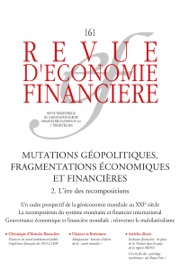
Under the joint guidance of Bruno Cabrillac, Director of the Foundation for Studies and Research on International Development (FERDI) and former Deputy Director General of the Banque de France, and Pierre Jaillet, former Director General (Economics and International Relations) of the Banque de France, Advisor at the Jacques Delors Institute - Notre Europe, and associate researcher at IRIS, issue 160 of the Revue d’économie financière adresses “Geopolitical shifts, economic and financial fragmentation”. It is being published both in French and English.
The significance of this subject has led the REF to devote two full issues to it. This first volume (“The Era of Disruption”) looks back at the successive shocks—the COVID-19 pandemic, the war in Ukraine, the energy crisis, inflationary pressures, and the rise of protectionism—that have forged a systemic “polycrisis”, which has revealed tensions arising from half a century of what is sometimes described as “happy globalization.” However, the fruits of this phase were unevenly distributed, and the extreme segmentation of global value chains has weakened the industrial bases of many advanced countries, making economies more vulnerable to geopolitical shocks.
Geopolitical tensions are helping redraw the map of international trade, and we are witnessing a rearmament effort that is unprecedented since the end of the Cold War and is sometimes referred to as preparation for a “war economy”. Sanctions against Russia have reinforced the antagonism between the Western bloc and the bloc dominated by China, which is fueled by tensions over control of energy, rare raw materials, and high-tech industries. The rise of digital technology is contributing to the fragmentation affecting payment systems and is raising questions about nations’ monetary sovereignty, while the US administration is using the still hegemonic dollar to its own advantage.
In the continuation of this volume, issue 161 (“The Era of Recomposition”) will examine the prospects opened up by this wide-ranging fragmentation: how will global economic hierarchies evolve within the context of Chinese-American rivalry? What role for a European Union in search of strategic sovereignty independent of these two blocs? How can the international monetary and financial system be reconfigured? Finally, what is the future for global governance at a time when multilateralism is breaking down, whereas global challenges require collective responses?