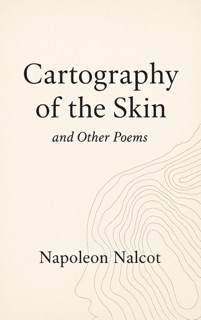
To read these poems is to wander through a map without borders, where the body becomes both terrain and witness—its scars rivers, its silences valleys, its touch a geography no atlas dares to keep.
Napoleon Nalcot writes as one who has learned that memory is not a straight road but a circling tide, always returning with sediments of sorrow and sudden light. Each poem lingers like rain against a window—sometimes patient, sometimes breaking, always carrying with it the faint murmur of what refuses to be forgotten.
Here the ordinary—steam rising from a chipped cup, the weight of a child asleep, the smell of rain on tin—turns luminous, becoming the very script by which we remember we are alive. Here, too, silence speaks: not as absence, but as a companion who waits in the room after everyone has left.
Cartography of the Skin and Other Poems is not a collection of answers but a book of echoes, a map of what we touch and lose and carry still. Enter it slowly, and you may find that the poems do not belong to the poet alone—they begin to speak with your own breath, your own scars, your own unfinished silences.