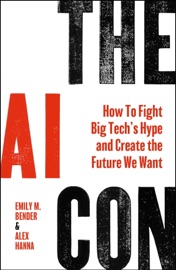
A smart, incisive work of technology criticism that examines the technologies sold as artificial intelligence, the drawbacks of systems sold under this banner, and why it’s crucial to recognize the many ways in which AI hype covers for a small set of power-hungry actors.
Is artificial intelligence going to take over the world? Have big tech scientists created an artificial lifeform that can think on its own? Is it going to put authors, artists, and others out of business? Are we about to enter an age where computers are better than humans at everything?
The answer to these questions, linguist Emily M. Bender and sociologist Alex Hanna make clear, is “no,” “they wish,” “LOL,” and “definitely not.” This kind of thinking is a symptom of a phenomenon known as “AI hype.” Hype looks and smells fishy: It twists words and helps the rich get richer by justifying data theft, motivating the surveillance capitalism that powers large language models, and devaluing human creativity to replace meaningful work with jobs that treat people like machines. In The AI Con, Bender and Hanna offer a sharp, witty, and wide-ranging take-down of AI hype across its many forms.
Bender and Hanna show you how to spot AI hype, how to deconstruct it, and how to expose the power grabs it aims to hide. Armed with these tools, you will be prepared to push back against AI hype at work, as a consumer, as a skeptical newsreader, and as a citizen holding policymakers to account. Together, they expose AI hype for what it is: a mask for Big Tech’s drive for profit and power, with little concern for who it affects.
This essential guide to tech ethics provides the critical thinking tools you need to see past the con:
Deconstruct AI Hype: Learn to spot the linguistic tricks and false promises that frame machine learning as magic, from “sentient” chatbots to the myth of superhuman intelligence.Expose Big Tech’s Power Play: See how a handful of powerful companies use the AI narrative to justify data theft, devalue human labor, and consolidate control over our digital lives.Focus on Real-World Harms: Move beyond science fiction doomsday scenarios to understand the actual, immediate dangers of biased algorithms, worker exploitation, and surveillance capitalism.A Social Science Perspective: Arm yourself with sharp, witty analysis from a linguist and a sociologist who reveal what’s truly at stake for our jobs, our privacy, and our world.