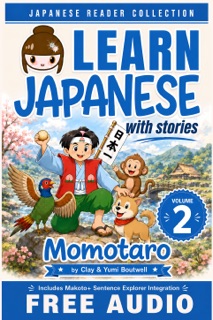
Read the most beloved folktale in Japan, broken down sentence by sentence for upper-beginner learners.
Almost every Japanese child can sing the Momotaro song before they can read it. The peach-born hero, his three animal companions, the journey to Oni Island — Momotaro is the story that lives in Japan's cultural water supply, referenced for the rest of a learner's life in conversations, manga, anime, and idiom. This volume gives you the language to read it in Japanese, with line-by-line vocabulary, grammar notes, native-speaker audio, and a simple English translation for self-checking.
New in the 2026 edition:
Bonus unlock code inside the book — redeem at MakotoPlus.com to study every sentence from this book interactively, on the web or in the mobile app (search "Makoto Japanese Explorer" in the App Store or Google Play)
New watercolor illustration and audio QR codes on every story's opening page
Hook teaser and Before-You-Read intro for each section, pointing you toward the grammar and vocabulary patterns to watch for
Resized furigana — ruby now sits closer to the base text, the way good Japanese typography should
Running headers, page numbers, and sumi-e section ornaments throughout
Updated front matter and refreshed layout series-wide
What's inside:
Five sections, each presented three ways: with line-by-line vocabulary, in plain Japanese for unscaffolded reading practice, and in English summary
Word-by-word breakdowns with furigana over every kanji
Grammar spotlights, cultural notes, and reading tips throughout
Full Exercises sections (Comprehension Questions, Particle Fill-in, Grammar Pattern Hunt, Translation Comparison + Answer Key) for Momotaro and the Tortoise
Free MP3 audio downloads — natural speed and slowed down — recorded by a native speaker
Free Anki decks for pre-study
Bonus unlock code for Makoto+ Sentence Explorer
No sign-up required to download the free audio
The five sections:
1. Momotaro, the Peach Boy — the full folktale, from the floating peach to the showdown on Oni Island.
2. The Momotaro Song — the children's song every Japanese person grows up with, lyrics and translation, plus a short essay on its 1911 origins.
3. Kibidango and Okayama — an essay on the millet dumpling that fuels Momotaro's journey, and the prefecture that claims him as a son.
4. What is an Oni? — an essay on the oni's evolution from mountain monster to Setsubun mascot.
5. The Tortoise and the Hare — Aesop's classic race, translated into Japanese during the Meiji era and beloved in schoolrooms ever since.
Who this is for: Upper-beginner to lower-intermediate learners. You'll need solid kana and a working sense of basic grammar. (New to hiragana? Take our free two-week crash course at TheJapanesePage.com/hiragana.)
Questions or requests for future readers? The authors' personal email addresses are inside the book.